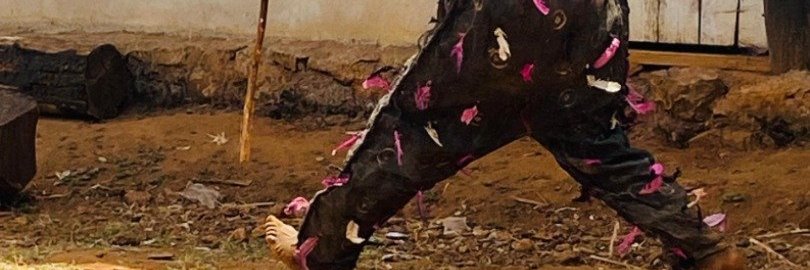

At a Glance
- Kibarankoh and Wanmabu are among the most respected traditional masqueraders of Mbiame Fondom.
- Kibarankoh comes from the Nwerong sanctum, while Wanmabu of the Ngiri sanctum.
- Both have defined ranks, rules, preparation procedures, movements and occasions of appearance.
- Mbiame recognizes three important forms of Kibarankoh: General Kibarankoh, Nine-Man Kibarankoh and Taakov Kibarankoh.
- Two principal forms are associated with Mabu: Mabu Samba Wir and General Mabu or otherwise known as Wanmabu
- Kibarankoh and Wanmabu appear during important occasions, including Mbiame Kpu Yi Wiyi Annual Festival, Funerals and the Deaths of important traditional figures.
- Their appearances follow prescribed sequences involving runs, whistles, chants, ropes and designated traditional objects.
- Beyond public display, the masqueraders represent authority, discipline, initiation, spirituality and cultural identity.
Introduction
The cultural heritage of Mbiame Fondom is sustained by a network of traditional institutions, practices and custodians whose roles extend far beyond ceremonial display.
Among the most respected and feared traditional masqueraders of Mbiame are Kibarankoh and Wanmabu.
Although similar forms of masqueraders may exist in other Fondoms of the Cameroon Grassfields, the Kibarankoh and Wanmabu of Mbiame have their own unique rules, ranks, preparation, movements and occasions of appearance. Their significance is particularly visible during traditional festivals, funerals and other important moments in the life of the Fondom.
Understanding these traditional masqueraders therefore requires looking beyond their outward appearance. They are part of a wider system of traditional authority, discipline, initiation and cultural identity.
Essential to Know!
The appearance of Kibarankoh and Wanmabu in Mbiame Fondom follows carefully defined traditional sequences. The followers of Kibarankoh first chant and run six times before Kibarankoh appears on the seventh run, while Wanmabu is preceded by two runs, with the third whistle signaling its speedy appearance.
Kibarankoh of Mbiame
Kibarankoh (Nkoh) is a swift and powerful traditional masquerader associated with the Nwerong sanctum of Mbiame.
Kibarankoh is accompanied by followers who move according to clearly defined ranks and positions.
At the end of the procession is a senior person who carries a directive spear and a directive calabash.
These are not ordinary ceremonial objects. According to Mbiame traditional practice, they may only be handled by a Tav Nwerong or Taa Nchilav who possesses the appropriate Nwerong name and traditional authority.
Kibarankoh is also associated with two traditional ropes. These ropes form part of the system used to control and direct the movement of the masquerader. Their handling is restricted to persons possessing the required traditional authority.
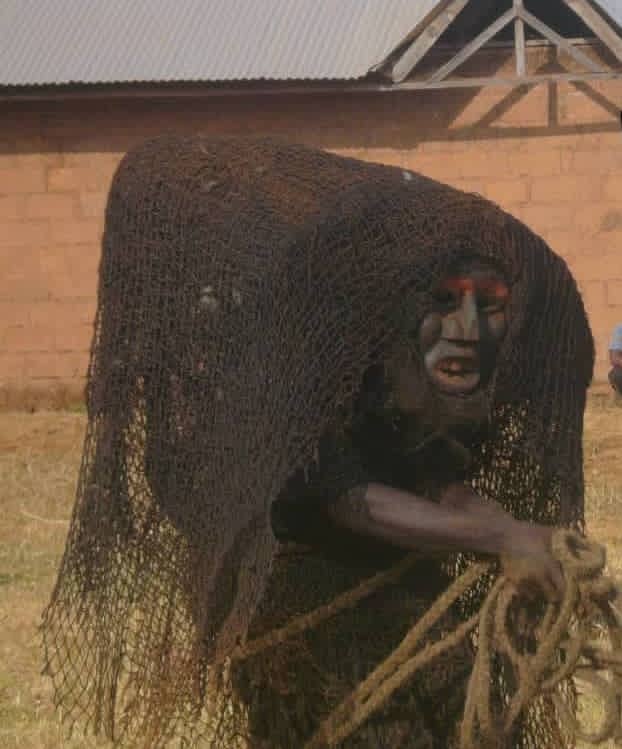
Fig 1: CLOSE VIEW OF THE DREADED NKOH MBIAME
Types of Kibarankoh in Mbiame
The Mbiame Nwerong sanctum has three important forms of Kibarankoh:
- General Kibarankoh — the principal Kibarankoh.
- Nine-Man Kibarankoh — associated with its own traditional structure and ranks.
- Taakov Kibarankoh — which comes out particularly during Mbiame Kpu Yi Wiyi.
These forms demonstrate that Kibarankoh is not simply one undifferentiated traditional masquerader. Its different forms are connected to particular traditional structures and occasions.
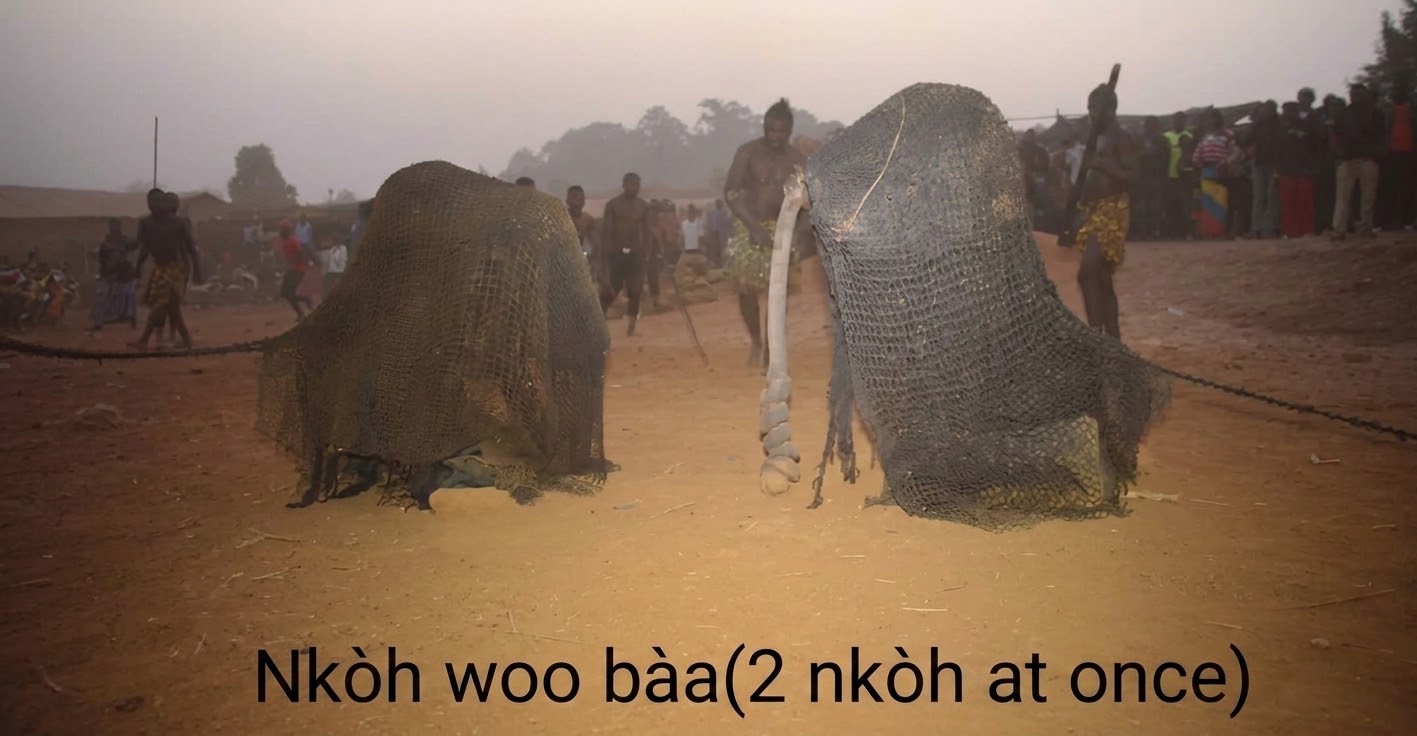
Fig 2: Nkoh Woo Baa Mbiame
When Does Kibarankoh Come Out?
Kibarankoh appears during occasions of major traditional importance.
These include:
- Kpu Yi Wiyi festivals (Mbiame Cultural Festival)
- The death of a member
- The loss of the Fon
- The loss of the Taawong
- The loss of the Yeewong
Its appearance is therefore not an ordinary event.
It is connected to moments when the traditional institutions of Mbiame play an especially important role in the life of the community.
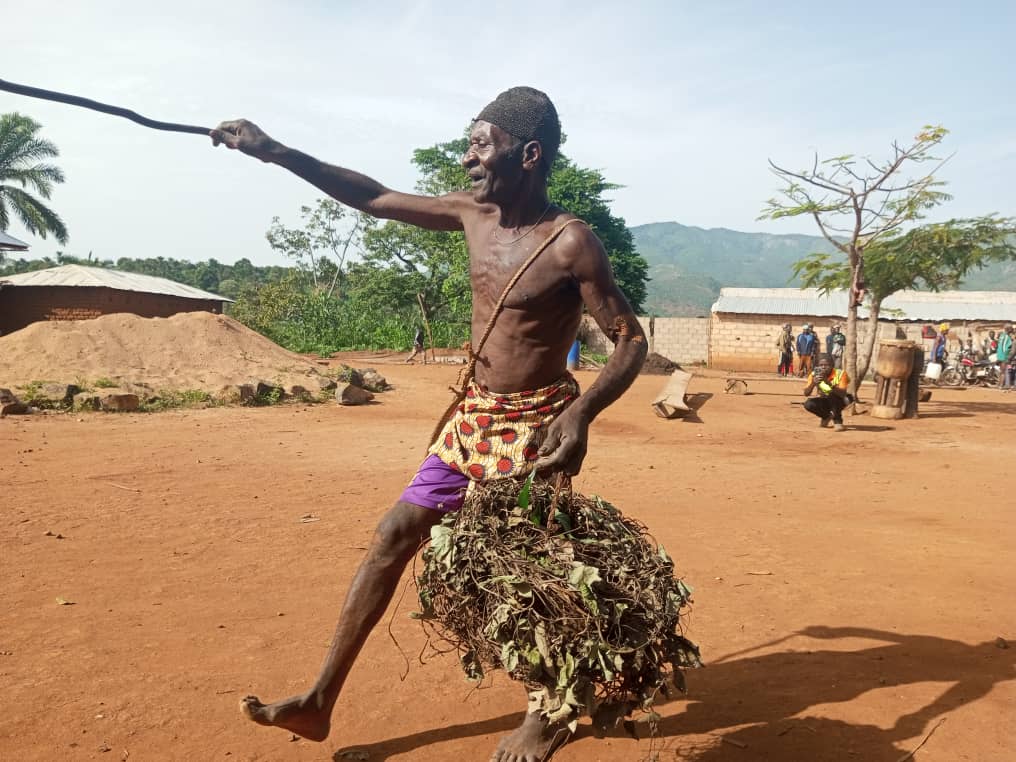
Fig 3: Ngang Nkoh Mbiame with Kighin
How Kibarankoh Is Prepared
Kibarankoh does not simply appear whenever people gather.
- Before it comes out, traditional sacrifices and preparations are carried out within the Nwerong sanctum.
- These preparations establish that the masquerader is permitted to appear.
- When everything is considered ready, the followers first come out and chant and run six times.
- On the seventh run, Kibarankoh comes out.
This sequence demonstrates the discipline, order and seriousness attached to the traditional masquerader.
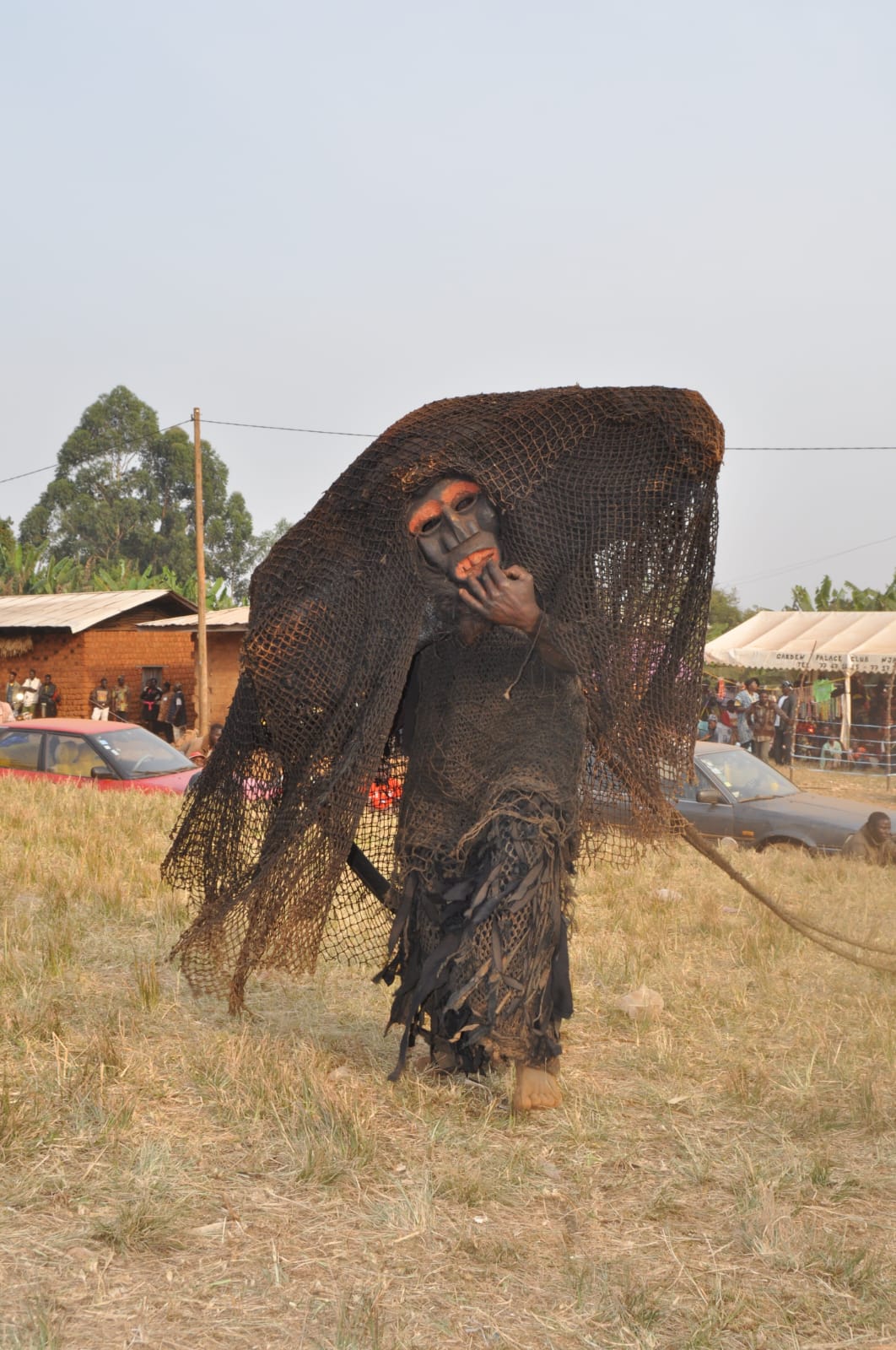
Fig 4: Kibarankoh ke Mbiame
Wanmabu of Mbiame
Wanmabu is another highly respected traditional masquerader of Mbiame.
It comes from the Ngiri sanctum and is known for its speed and distinctive display.
The people who lead Wanmabu are arranged in ranks, with their positions marked by traditional signs of rank and authority within Mabu.
The organization of the procession is therefore not accidental. It forms part of the traditional structure governing Wanmabu's appearance.
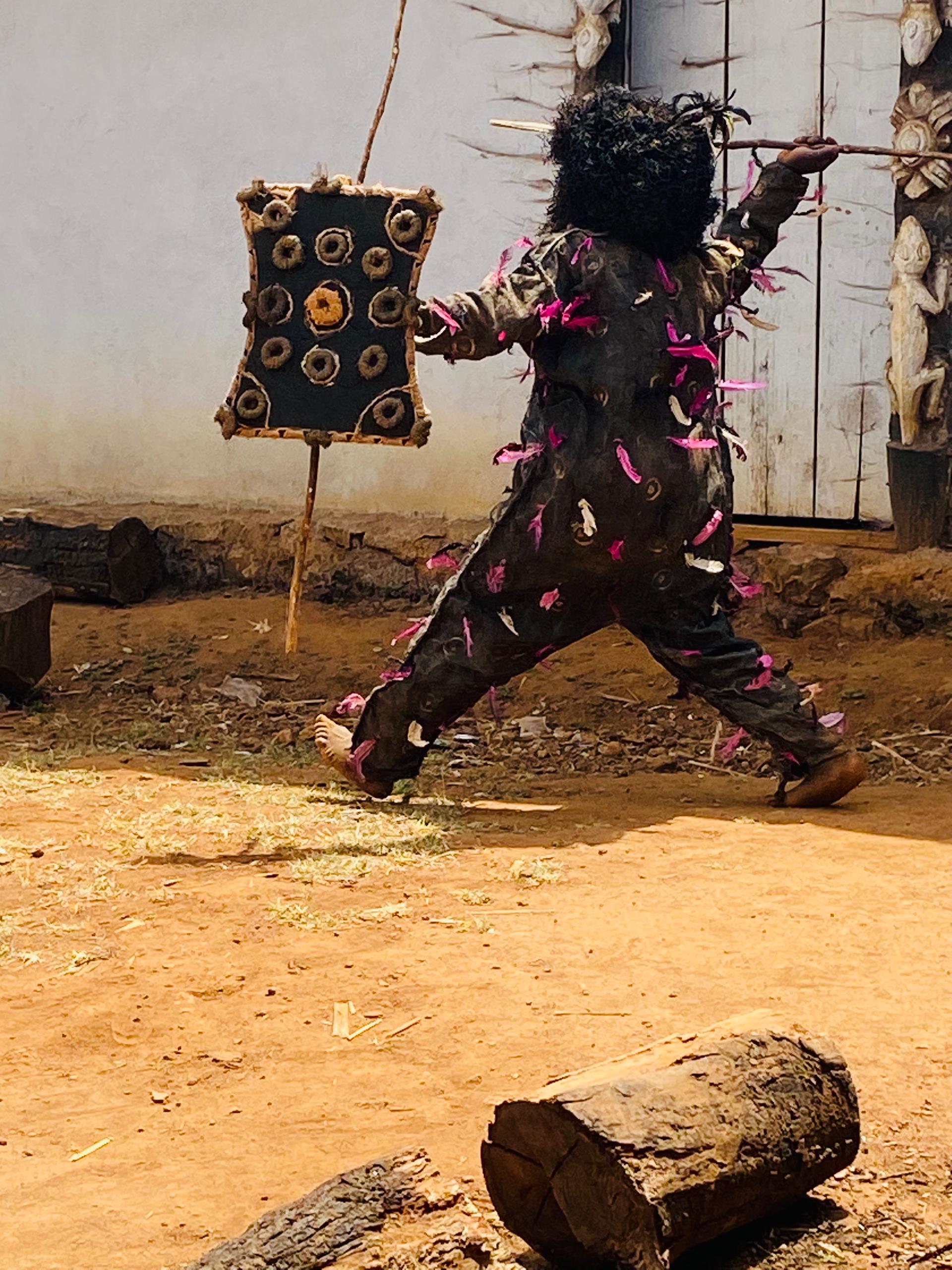
Fig 5: WANMABUH SAMBAWIR MBIAME IN ACTION
Principal Forms of Mabu Associated With Wanmabu
Two principal forms are recognized:
- Mabu Samba Wir
- General Mabu
These forms are part of the traditional organization surrounding Wanmabu and Mabu.
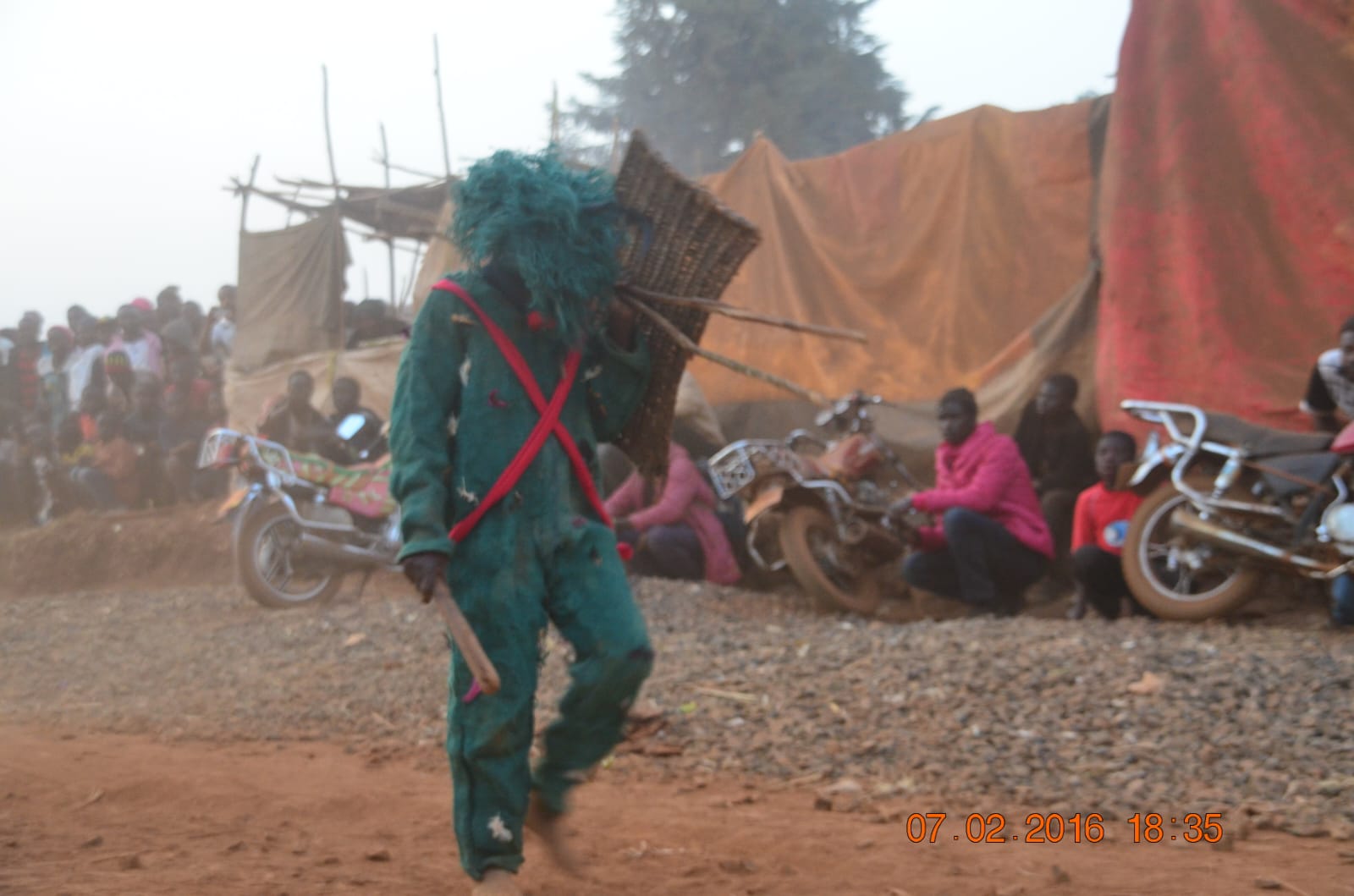
Fig 6: WANMABUH MBIAME
The Leading Ranks of Wanmabu
The final two persons in the Wanmabu procession have special responsibilities.
One carries a directive cup and chants.
The other carries a directive spear, together with a medicinal garden fruit, and also chants.
Their positions and the objects they carry reflect their rank and responsibilities within Mabu.
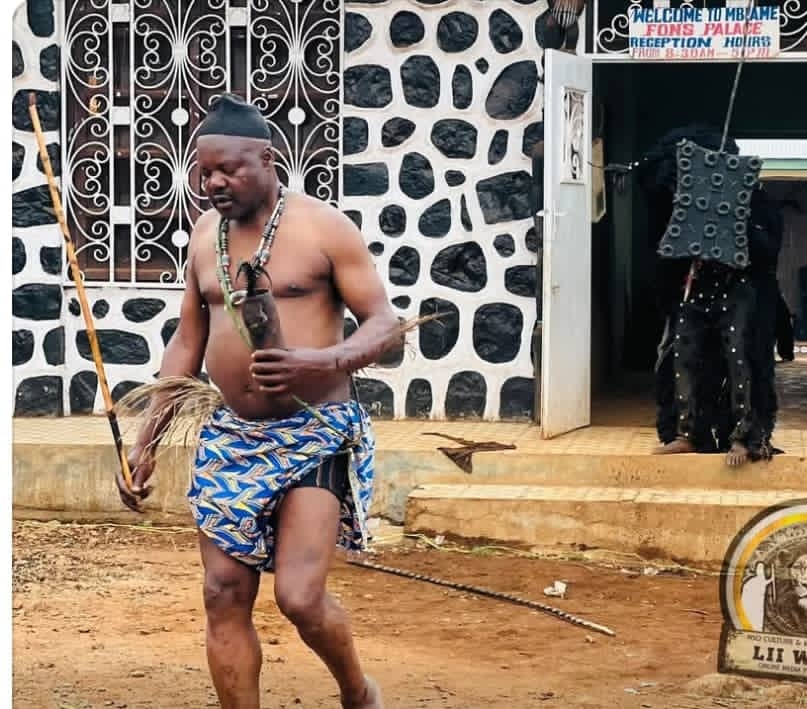
Fig 7: NGANG WANMABUH SAMBAWIR WITH ORNAMENTED CUP (BAR) .jpg
When Does Wanmabu Come Out?
Wanmabu appears during important traditional occasions such as:
- The death of a bona fide member
- Kpu Yi Wiyi Festivals
- The loss of the Yeewong
- The loss of the Taawong
- The loss of a Princess
- The loss of the Fon
Its appearance is therefore carefully connected to events that are significant to the Mbiame community.
How Wanmabu Is Prepared
Like Kibarankoh, Wanmabu does not simply appear without preparation.
- Traditional sacrifices and other preparations are carried out within the Ngiri sanctum before it is allowed to come out.
- There are three whistles associated with its appearance.
- The followers first run out twice.
- The third whistle signals the speedy coming out of Wanmabu.
This sequence is part of the traditional discipline governing its appearance.

Fig 8: WANMABUH MBIAME IN DISPLAY
The Medicinal Rope of Wanmabu
Wanmabu is also followed by a medicinal rope.
The rope is held by people who have completed the required initiation in the Mabu house.
The rope helps to control the movement of the masquerader.
According to Mbiame tradition, Wanmabu cannot cross the rope, preventing it from moving into places where it is not supposed to go.
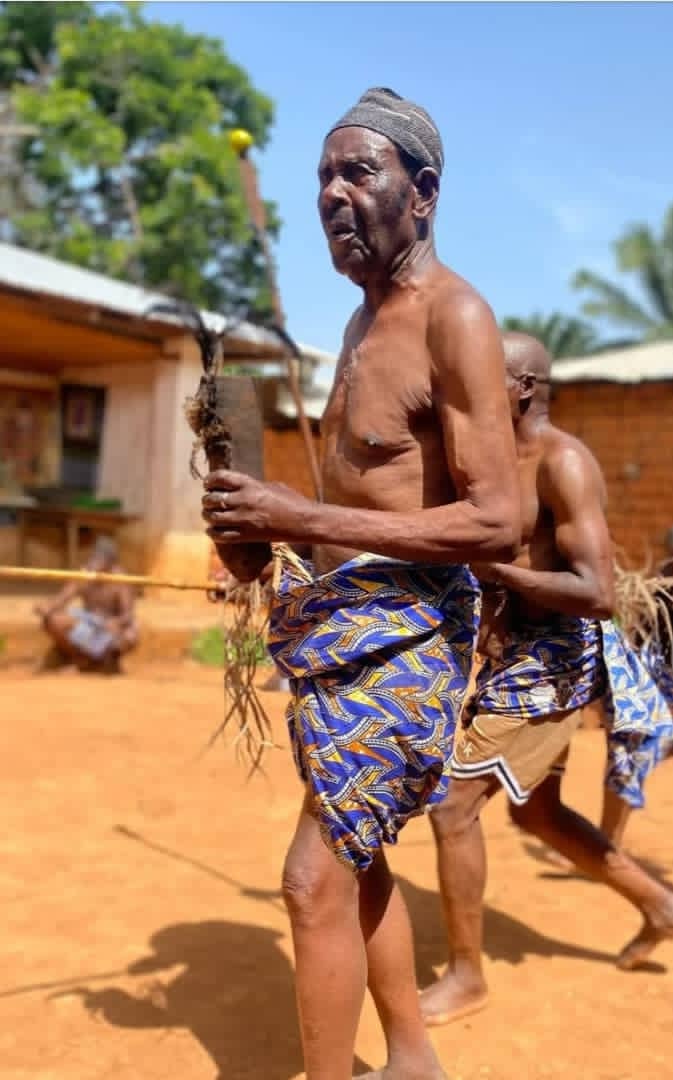
Fig 9: SENIOR NGANG SAMBAWIR MBIAME
Rules, Initiation and Respect
Both Kibarankoh and Wanmabu are governed by traditional rules.
Membership and initiation are not open to everyone.
A person must meet the requirements established by the respective traditional institution and provide what is traditionally required before being initiated.
The traditional masqueraders are also associated with traditional medicines and sacred practices. Members and followers are therefore expected to understand and respect the restrictions surrounding them.
One important traditional restriction is that non-members, particularly women, are not permitted to touch the masqueraders or certain sacred objects associated with them.
These restrictions are not simply about fear.
They help preserve the:
- Authority of the institutions
- Secrecy surrounding restricted knowledge
- Discipline of members
- Sacred character of traditional practices
- Cultural identity of Mbiame
Kibarankoh and Wanmabu: A Distinction
Although Kibarankoh and Wanmabu share some similarities, they are distinct traditional masqueraders associated with different Mbiame institutions.
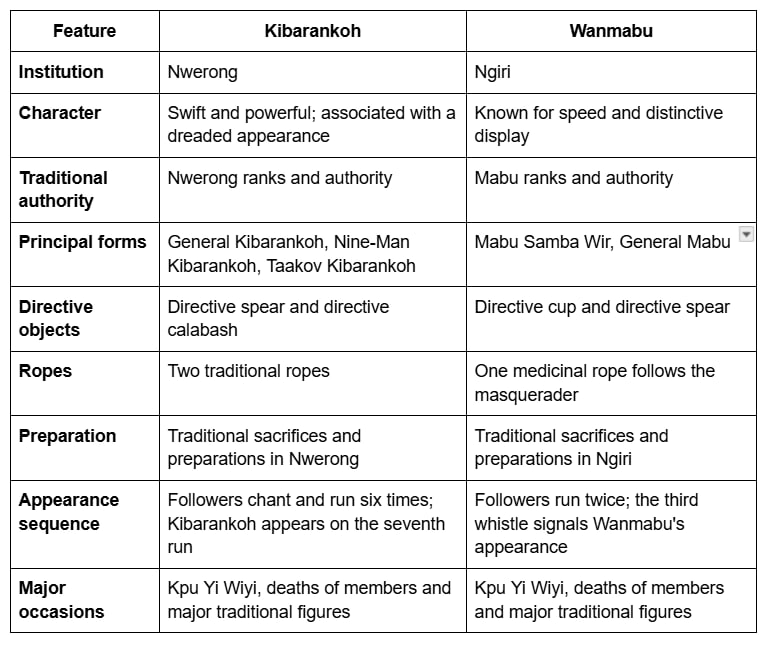
These differences demonstrate that Kibarankoh and Wanmabu are not interchangeable.
Each belongs to its own traditional institutional structure, with its own ranks, objects, procedures and responsibilities.
Kibarankoh, Wanmabu and Mbiame Traditional Institutions
To understand these masqueraders properly, it is important to understand their institutional origins.
Kibarankoh comes from Nwerong, while Wanmabu comes from Ngiri.
This distinction reflects the broader organization of Mbiame traditional institutions.
The masqueraders are therefore not independent performances created simply for public entertainment.
Their existence, preparation and appearance are connected to institutions that have their own authority and traditional responsibilities.
This is why the people who handle their traditional objects, control their movements or occupy positions within their processions must possess the appropriate traditional standing.
Their Role During Funerals and Major Traditional Events
One of the clearest ways to understand the importance of Kibarankoh and Wanmabu is to observe when they appear.
Both are associated with death, mourning and major traditional ceremonies.
Their presence during such occasions connects them to the collective life of the Fondom.
They form part of the traditional response to important events affecting individuals, families and the wider community.
Their appearance also demonstrates that traditional ceremonies are structured events governed by established procedures.
The chants, movements, ranks, traditional objects, preparation and restrictions all contribute to the meaning of the occasion.
.jpg)
Fig 10: WANMABUH MBIAME IN DISPLAY
More Than Entertainment
To an outside observer, a traditional masquerader may appear primarily as a visual performance.
In Mbiame, however, Kibarankoh and Wanmabu carry a deeper significance.
They are connected to:
- Traditional authority
- Initiation
- Discipline
- Sacred practice
- Traditional medicine
- Community responsibility
- Funeral traditions
- Institutional identity
- Cultural continuity
Their public appearances are therefore only the visible part of a much larger traditional system.
Much of the knowledge surrounding the masqueraders exists within the institutions themselves and is transmitted through initiation and traditional custodianship.
A Tradition With Its Own Mbiame Identity
Masqueraders serving similar broad cultural functions may exist in other Fondoms of the Cameroon Grassfields.
This is not unusual.
Different communities can develop institutions that address related cultural needs, particularly around funerals, initiation, social discipline, traditional authority and ceremonial life.
However, similarity does not mean sameness.
Each Fondom has its own historical development and traditional system.
The following may differ from one community to another:
- The name of the masquerader
- Its institutional affiliation
- Its ranks
- Its initiation requirements
- The people permitted to handle traditional objects
- Its preparation
- Its chants
- Its movements
- Its restrictions
- The occasions on which it appears
- The meaning attached to particular objects
Kibarankoh and Wanmabu should therefore be understood specifically within the Mbiame traditional system.
Their identity comes from the institutions, history and practices through which Mbiame has preserved them.
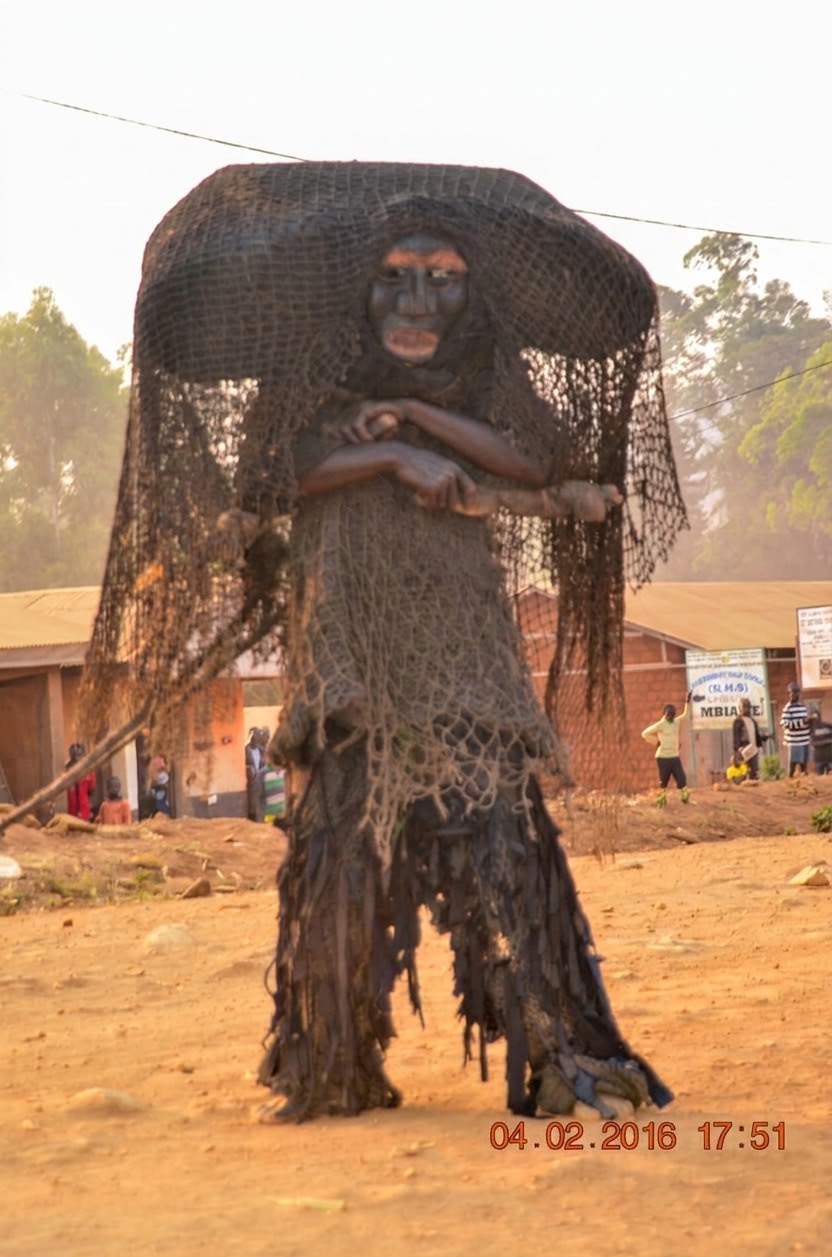
Fig 11: KIBARANKO KE MBIAME
Preserving the Knowledge of Kibarankoh and Wanmabu
Much of the knowledge surrounding traditional masqueraders is transmitted orally.
As generations change, there is a growing need to document what can appropriately be documented while continuing to respect the restrictions governing sacred institutions.
Documentation should not mean exposing information that is traditionally restricted.
Rather, it should preserve knowledge that can responsibly be shared about:
- The names and identities of institutions
- Their historical significance
- Their public roles
- Their cultural meaning
- Their occasions of appearance
- Their ranks and organization
- Traditional objects that can be publicly described
- Their role in the wider life of the Fondom
The preservation of such knowledge helps ensure that future generations understand that these traditions are part of a living cultural system, rather than relics of the past.
Conclusion
Kibarankoh and Wanmabu are important expressions of the traditional heritage of Mbiame Fondom.
Kibarankoh, associated with Nwerong, and Wanmabu, associated with Ngiri, each operate within a carefully defined traditional structure.
Their ranks, traditional objects, ropes, chants, preparation procedures, initiation requirements and prescribed occasions of appearance demonstrate the depth of the institutions behind them.
They are particularly visible during Kpu Yi Wiyi, funerals and other major traditional events, where their presence forms part of the wider cultural response to important moments in the life of the community.
For Mbiame, these traditional masqueraders are therefore more than performances.
They are carriers of authority, discipline, tradition and cultural memory.
Their continued respect and preservation are part of the broader responsibility of safeguarding the heritage and identity of Mbiame Fondom for generations to come.
References
- Mbiame Palace Archives.
- Woó Fém Maimo. Senior Ngang Ngiri and Staunched Member of Samba Wir Mbiame Cult.
- Berinyuy, Jude. (2025). Mbiame in the Beginning, Yesteryears and Nowadays. Yaoundé: Nyaa Publishers.
Author: MAIMO BRENDAR CHIN (Woó Fém Mbiame)
EDITOR(s): AYUVEA ANGELO T./ JUDE T. BERINYUY